Raise Curious, Capable Kids
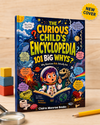
WHY?" Kids' Comic Encyclopedia
Finally, An Answer For Every “Why?”
- Comic-style Q&A answers to the questions kids actually ask
- Covers Animals, Human Body, Space, Emotions, Geography & Daily Life
- Hardcover build made for years of rereading, not one summer
What's inside
Comic-style Q&A spreads answering the questions kids actually ask, organized across Animals, the Human Body, Space, Emotions, Geography and Daily Life. Hardcover build made to survive years of rereading, not just one summer.
Shipping & delivery
Processing time
Orders are processed within 1–3 business days.
Delivery time
Domestic (U.S.) orders typically arrive within 5–10 business days once shipped. International delivery times vary by destination and generally take longer. You'll receive a tracking number via email once your order has shipped.
Where we ship
We ship internationally, including to the United States, Canada, Australia, New Zealand, and many other countries.
What Readers Are Saying

not gonna lie i bought this mostly to get a break from answering "why" 900 times a day. wasn't expecting my 4 yr old to actually sit with it for 20 min straight. she just flips to whatever page has a picture that catches her eye and makes me read it to her. worth it just for the car ride silence tbh.


my son is NOT a reader. teachers have said it, we've tried everything. this is the first "book" he's picked up on his own without me asking. i think it's because it looks like a comic and not a school thing. still shocked.


got this for my grandkids' birthday instead of another toy that'll be broken in a week. hardcover feels sturdy which mattered to me since these two are rough on books. they've asked for it every visit since.


we use this as a supplement during our science block. the comic format holds my youngest's attention way better than our usual textbook-style resources. it doesn't feel like "extra work" to her, she thinks she's just reading for fun.


road trip tested. we did 6 hours to see family and this thing single handedly prevented at least 3 meltdowns. my daughter reads the questions out loud to us which was an unexpected bonus, whole car got involved.


the screen time guilt is so real and this is the first thing that's actually gotten her to ask for the book instead of the tablet after dinner. not every night but genuinely more than i expected. bedtime routine feels calmer now.


The “Why Phase” Is Real Brain Development, Not a Phase to Survive
Somewhere around age 3, most kids' brains hit a real developmental leap: they start building cause-and-effect reasoning, and it shows up as a nonstop stream of “why” questions, sometimes over 100 a day. It can feel endless, but researchers who study it (Chouinard, 2007) describe it as an “Information Requesting Mechanism”, a built-in tool kids use to gather knowledge exactly when they need it.
Here's the part most parents don't know: a 2009 study (Frazier et al.) found preschoolers were measurably more satisfied, nodding, agreeing, asking real follow-ups, when adults gave them an actual explanation instead of a vague brush-off like “because I said so.” Kids who don't get a real answer are more likely to just keep repeating the question. They're not being difficult. They're still waiting for the answer.

Screen Time Guilt Is at an All-Time High, and It's Not About the Hours
Parental guilt over screen time has been climbing fast. A 2026 Lingokids study found 84.6% of parents feel guilty about their kids' screen use, even though 98% of parents allow it anyway, researchers are calling it the “Screen Guilt Paradox.” A separate Pew Research survey backs this up: even small amounts weigh on parents, with one parent describing it simply: “I feel guilty because even if it's 15 or 20 minutes on the tablet, that's time we could spend together.”
The interesting part is what actually drives the guilt. It's rarely the number of minutes. Parents overwhelmingly cite content quality and the feeling that a screen has become a stand-in babysitter, not the screen itself. That's a solvable problem: giving a kid something screen-free to reach for in the exact moments a tablet usually comes out.

Comics Get Reluctant Readers to Actually Pick Up a Book
This isn't just a hunch, it's documented in literacy research. Studies on graphic novels and reluctant readers consistently find that kids who read in comic format read a greater volume overall, report more positive attitudes toward reading, and develop a stronger sense of themselves as “a reader” compared to kids given only prose. Critically, researchers also found that reading comics doesn't crowd out other reading, kids who read graphic formats tend to read more prose too, not less.
The reason comes down to how the format works: the images provide context clues right alongside the words, and panel breaks give natural resting points that make the page feel manageable instead of overwhelming, which is exactly what turns a “my kid won't read” situation into a kid quietly working through a book on their own.
Our Book Versus Other Books
| WHY? Comic Encyclopedia | Other books | |
|---|---|---|
| Comic-style storytelling with recurring characters | ||
| Hardcover binding built for years of rereading | ||
| 6 broad topics in one book (Animals, Body, Space, Emotions, Geography, Daily Life) | ||
| Designed to be read together as a bonding routine | ||
| Screen-free, no app or login required |

By the numbers
Why This Matters Right Now
of U.S. parents report feeling guilty about their child's screen time, even when they know it's sometimes necessary (Lingokids Parent Guilt Study, 2025)
the peak of the “why phase,” when a child's brain is building the cause-and-effect reasoning that drives nonstop questions, sometimes 100+ a day (child development research on causal reasoning)
average rating from parents who've read it with their kids
From Purchase to Confidence
-
Phase 1
Open To Any Page
No need to start at page one. Grab it during a car ride, a rainy afternoon, or right before bed, every entry stands on its own.
-
Phase 2
Let Them Ask, Then Show Them
When your kid asks a “why,” flip to it together instead of guessing. The comic panels do the explaining for you.
-
Phase 3
Watch the Facts Actually Stick
Real explanations satisfy kids' curiosity in a way “because I said so” never does, and research shows they stop repeating the question once they get one.
-
Phase 4
Revisit Their Favorite Answers
Kids naturally circle back to the answers that surprised them most. That repetition is what turns a fact into something they remember for good.
-
Phase 5
Curiosity Turns Into Their Own Habit
Eventually, the book becomes the first place they reach before the tablet, before “can I watch something.”
Optional add-on
Want To Go Further?
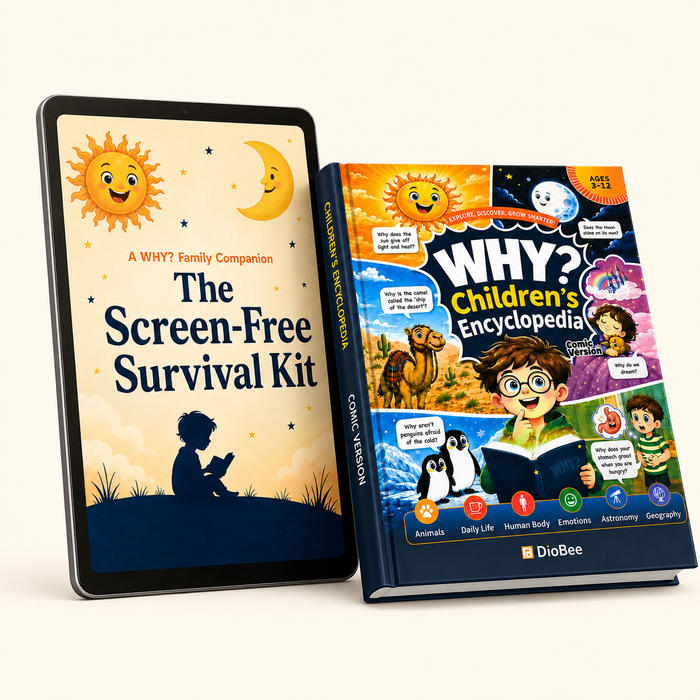
The Screen-Free Survival Kit: A WHY? Family Companion(E-BOOK)
The Screen-Free Survival Kit is the thing you reach for instead of the tablet, ready-to-use games, scripts, and calming rituals for the exact moments a screen usually comes out.
- 8 car games and 6 whisper-quiet games for restaurants and waiting rooms
- A full bedtime wind-down system with three original calming stories
- Situation-specific parent scripts for meltdowns in public
- 30 bonus "why" questions with real answers to keep the curiosity going
Is This Right For You?
This Is For You If
Kids who ask "why" constantly, and parents who want comic-style, ready-made answers instead of reaching for a screen.
Frequently Asked Questions
The problem most people face
Kids in the “why phase” can ask upwards of 100 questions a day, it's a real, well-documented stage of brain development, not them trying to annoy you. The problem is most parents don't have a simple, accurate answer ready, so the tablet comes out instead. Then the guilt sets in. This book is built to be the thing you reach for instead.
My kid isn't really a reader, will this still work?
Yes, that's exactly who this format is built for. Kids who resist “regular” books often light up for comics, because it feels like something they chose to open, not homework. Younger kids can enjoy it read-aloud through the pictures alone; older kids read it independently.
Does it include activities, or just facts?
Every entry is a question-and-answer comic spread, simple, accurate explanations kids can actually follow, not a quiz or workbook. It's built for reading and re-reading, not busywork.
I've read other “why” books, how is this different?
Most “why” books on the market are static text-and-clipart Q&A pages, a list of facts to skim. This one tells every answer through comic panels with recurring characters, so it reads like a story your kid follows, not a page they skip past.
What's this e-book bundle?
A 55-page digital guide (PDF) designed to be read on your phone or tablet, not printed. It's organized into 6 parts covering car rides, restaurants/waiting rooms, bedtime, meltdown moments, and bonus content, so you can jump straight to whatever situation you're in.
Shipping and delivery
Orders are processed within 1–3 business days. Domestic (U.S.) orders typically arrive within 5–10 business days once shipped, international delivery times vary by destination and generally take longer. You'll receive a tracking number via email once your order has shipped. We ship internationally, including to the United States, Canada, Australia, New Zealand, and many other countries.